

VSF Oyster Perpetual 36 Jubilee Dial Review: Ref. 126000 Photo Analysis
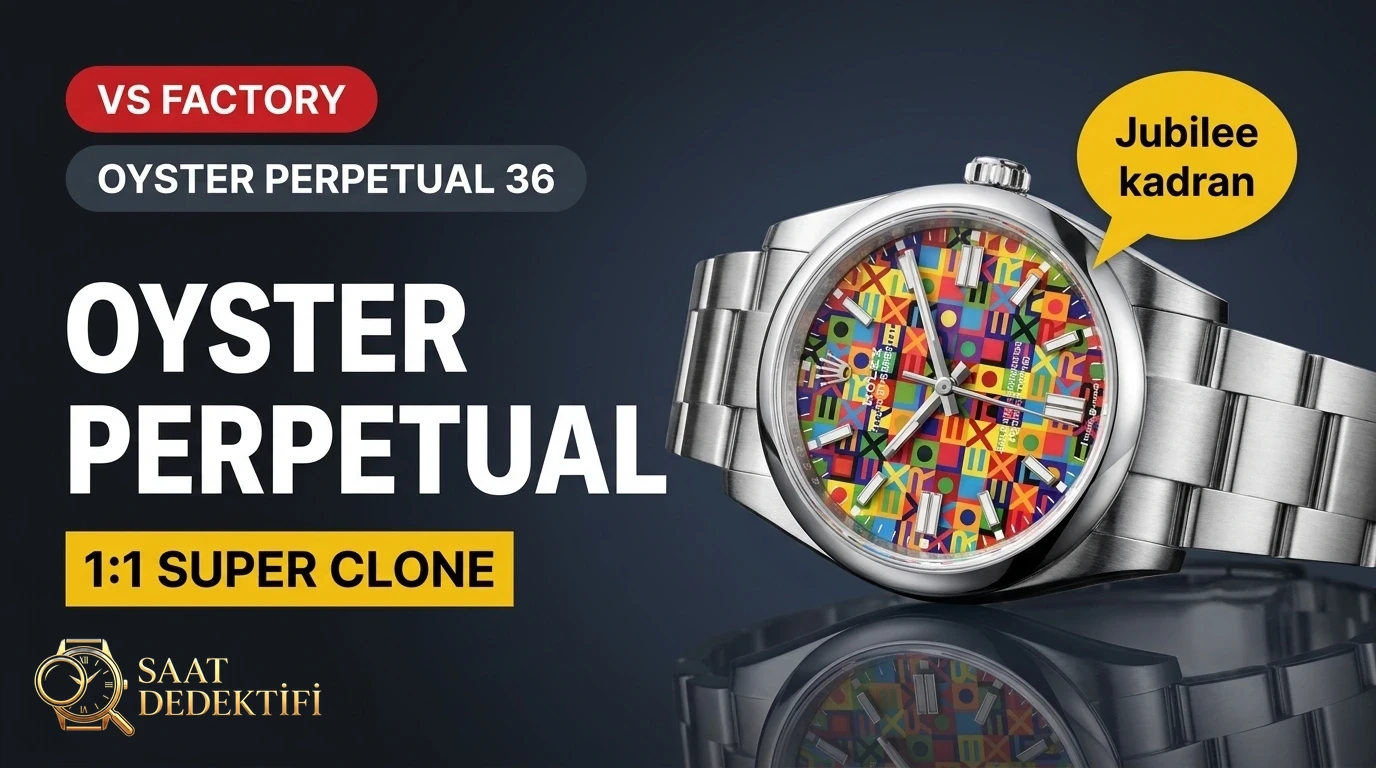
The Rolex Oyster Perpetual 126000 model is produced by VS Factory with a solid stainless steel case, standard case diameter and high-precision automatic Super Clone movement architecture. It is among the most successful 1:1 super clone watch reviews on the market, with its sapphire crystal AR coating glass, original case tolerances and detailed workmanship.
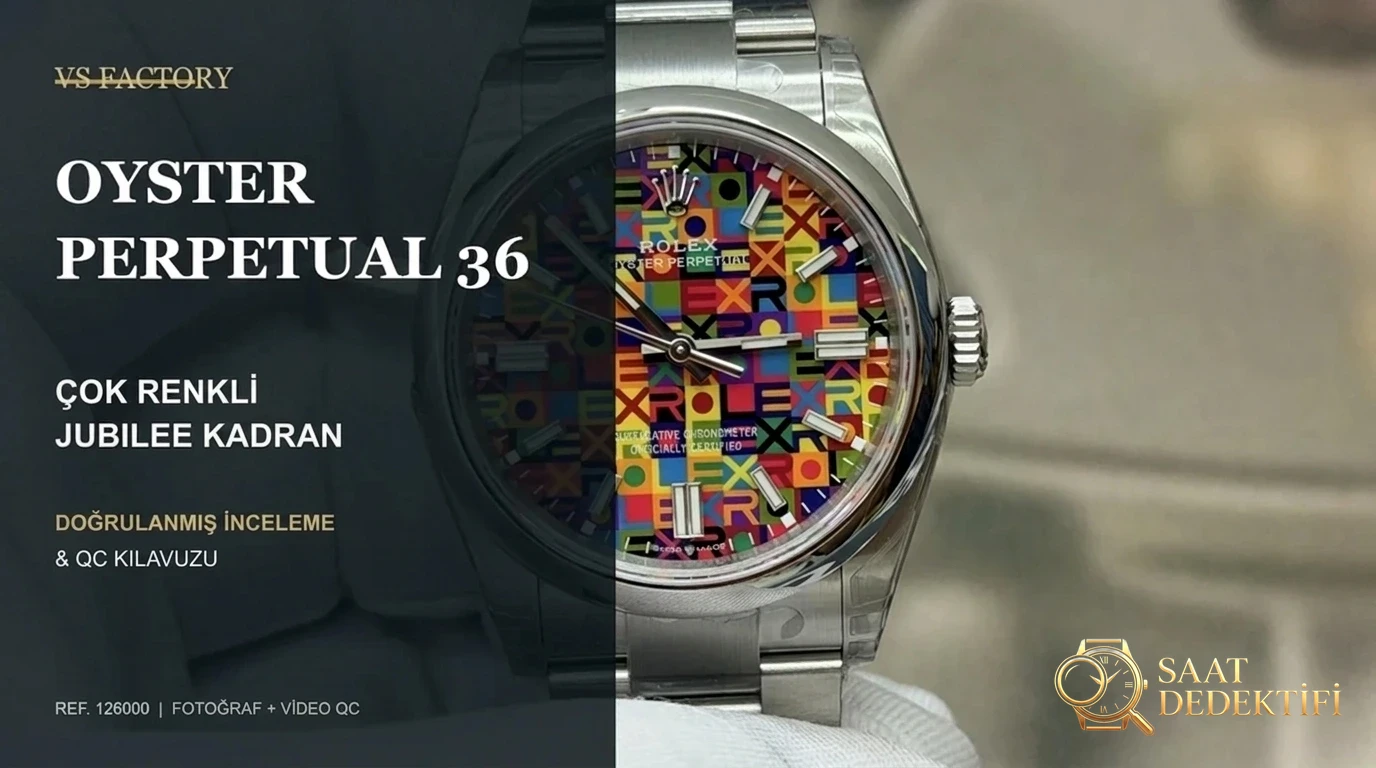
ThisVSF Oyster Perpetual 36 Jubilee dial review is created with one practical purpose: to help the buyer read actual photos, video and product registration before endorsing a watch. The subject is the linked VS Factory ad featuring catalog reference 126000, SKU VSF-19117, an Oyster type band, and a DD3230 movement listed by the supplier.
Repeating colored letters make the dial unusually revealing. Alignment, print limits, index fit and hour-minute hand position can be checked against a dense grid. At the same time, this visual complexity makes it easier to hide exaggerated technical claims. This guide therefore distinguishes between what Rolex documents for the original design, what the supplier lists for the VSF product, and what is directly visible in the media.
| Technical Parameter | Original Reference | VS Factory 1:1 Super Clone | Market Clone models |
|---|---|---|---|
| Case & Size | Full Reference Measurements | 1:1 Exact Laser Measurement | Rough Case Profile |
| Body Material | Solid Oystersteel/Metal | Solid 904L Steel / Coating | 316L Plain Steel |
| Mechanism | Original Swiss Caliber | DanDong Special Clone caliber | Asian ETA / 2824 Module |
| Power Reserve | 65-72 Hours | 68-72 Hours Full Reserve | 36-40 Hours |
| Sapphire Glass | Anti-Reflective Coating Sapphire | AR Coated Sapphire Crystal | Standard Mineral / Glass |
| Waterproof | Original Depth Rating | 100m Static Pressure Test | Hand Wash Only |
1. Identity, Method and Levels of Evidence
The model reviewed is the VSF Oyster Perpetual 36 (Ref. 126000) Jubilee Dial review. The five body photographs in the source record match the catalog files for this product, byte for byte. Match; Since it includes the dial, crown-side case, back cover, closed clip, and open clip, identification does not rely on a similar-looking thumbnail.
An earlier source post labeled the image set as a 41mm / 124300 watch; five matching files and product mapping correct the catalog ID under review to 36 mm / 126000. The sixth body image is different: this is a generic previously used movement photo, not a matching image from this product's ten-image gallery. What remains below is never as proof that this sample was opened, but as a clearly labeled educational reference.
Three levels of evidence are used throughout the article. Original reference base means the information specified by Rolex for the original m126000-0016. Supplier listed means a catalog label on the VSF product, such as DD3230. Visible observation means a feature that can be examined in the provided images or matching product video. None of these levels should be silently substituted for another.
| layer of evidence | What does it reveal? | What does it not reveal? |
|---|---|---|
| Original Rolex basis | Official design name, context of reference, Jubilee-motif nomenclature and original configuration. | Materials, tolerances, performance or test results of a VSF sample. |
| Supplier catalog | Product ID, SKU, catalog size family, mechanism label, and media assigned to the listing. | Independent measurement, internal origin, speed, power reserve, waterproof seal or durability. |
| Photos and video | Visible dial layout, exterior workmanship, back cover, strap, clip and usage appearance. | Metal composition, hidden structure or unrecorded functional performance. |
2. Celebration Dial Versus Jubilee Motif
Rolex calls the original design amulticolored, Jubilee-motif dial. Its structure is typographic: the letters R, O, L, E and X are repeated as a geometric space across the surface. Rolex's official model sheet and Newsroom presentation explain that at least ten colors were applied in succession, requiring precise positioning for shapes and letters.
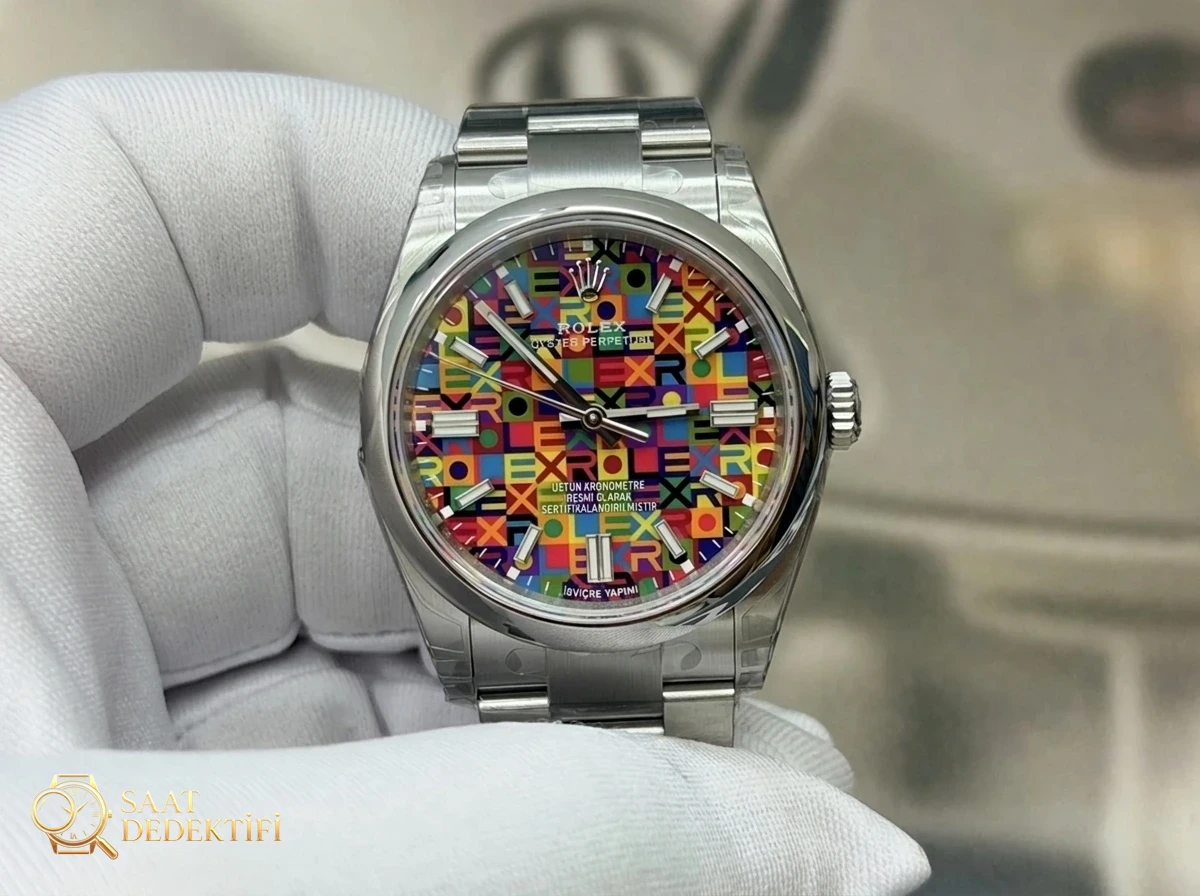
This description is a reference to understand the original dial, not a production certificate for the sample. In the front-on photograph provided, the relevant observable facts are simpler: the letters are visibly repeated, blocks of color form a dense full-surface pattern, and the white dial lettering and appliqué baton indices sit atop this pattern.
A Celebration dial is visually different. Instead of a repeating grid of letters, it uses interlocking circular bubbles on a turquoise field. Because they are both cheerful and very colorful, these two designs are often grouped together in casual searches, but using the terms interchangeably can lead a buyer to the wrong product, wrong reference images, and wrong QC expectations. While Hodinkee's introduction based the Jubilee monogram idea on older Rolex motif dials, Monochrome's hand-test report similarly describes the letters and individually applied colors. Both provide independent context for the original watch.
3. QC of Dial, Print and Hour and Minute Hands
Start with the entire dial before zooming in. The colored letter field should be read as a continuous composition, without a distinct blank region, a rotated segment, or an abrupt break that cannot be explained by an index. Since the motif provides numerous horizontal and vertical cues, a visibly offset index or curved line may stand out more here than on a plain lacquered dial.
Then use the double indices in the cardinal directions and the minute track as reference lines. Check that the crown and index group at twelve o'clock are aligned on the vertical axis, the subtitle is centered, and the central stack of hour and minute hands looks neat. A phone image taken off-axis may show one side of the rehaut, or minute track, wider; Therefore, confirm a suspected alignment problem with a second photograph taken straight ahead rather than relying on a single perspective.
Then examine the print limits. Source photo; It's useful for finding obvious color bleed, missing letter segments, dust, or damage, but it's not a calibrated macro test. Compression, sharpening, and white balance processing can create halos along high-contrast edges. If a color border looks blurry, ask for an unfiltered close-up under diffused light.
Finally, consider readability, not just saturation. The same dial may appear dull in soft indoor light and much more intense under a directional lamp. A buyer should compare at least one frontal still image, one angle still image, and video before deciding a tone is wrong. More importantly, the polished index frames, hour and minute hands, and white text must remain readable against this busy background.
4. Flat Frame Case Profile and Closed Back Cover
The crown side photo shows the distinctive watch-only profile: flat bezel, curved case side, winding crown and first strap links. Use this to examine transitions, not to estimate sizes. The bezel should appear concentrically seated, the crystal-bezel boundary should appear smooth, and the crown should not appear visibly tilted relative to the case tube. Compare the upper and lower ear silhouettes for a general symmetry check.
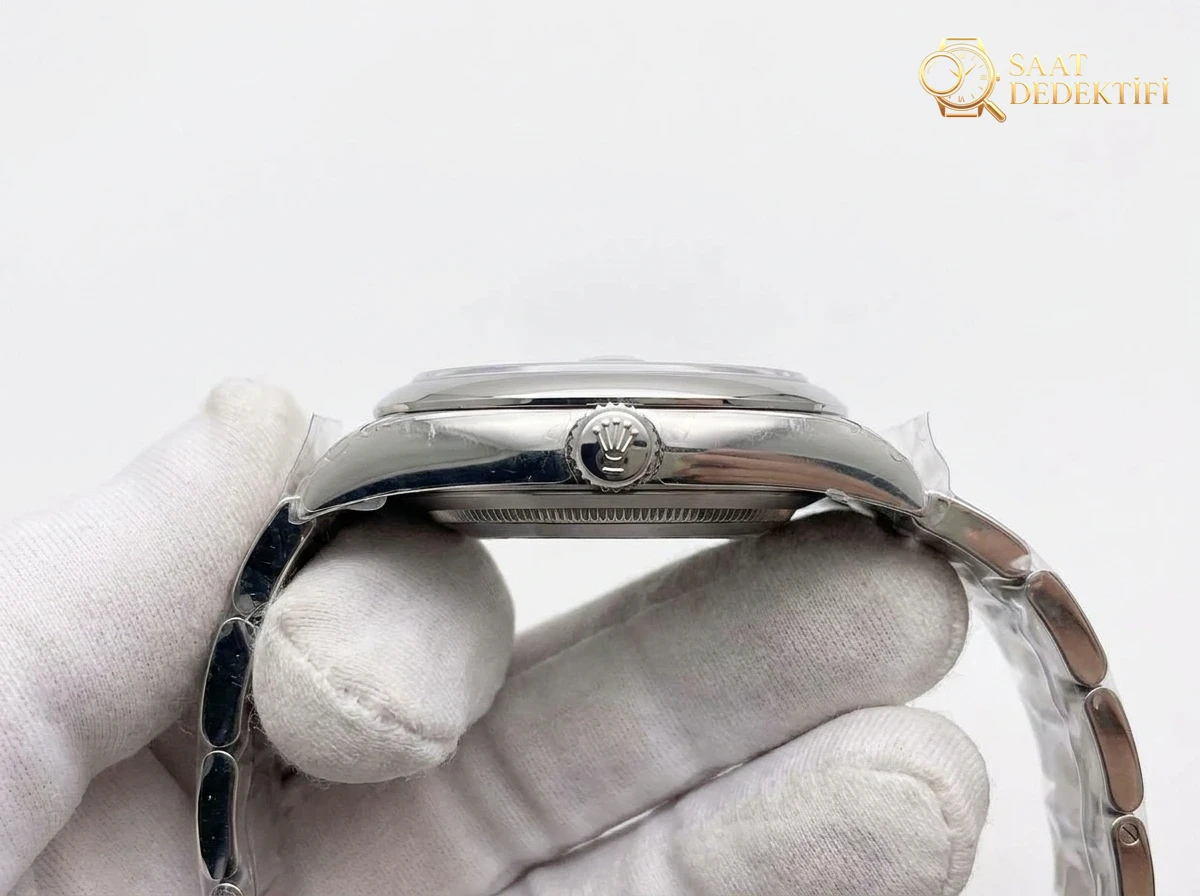
Polished surfaces are extremely sensitive to light. A clean shine can show continuity, but it cannot eliminate a line that lies outside the reflected band. For full-unit QC, request one scattered light image and one diffuse light image of each case face. The protective film must be identified because its edges, air bubbles and trapped dust may resemble workmanship defects.
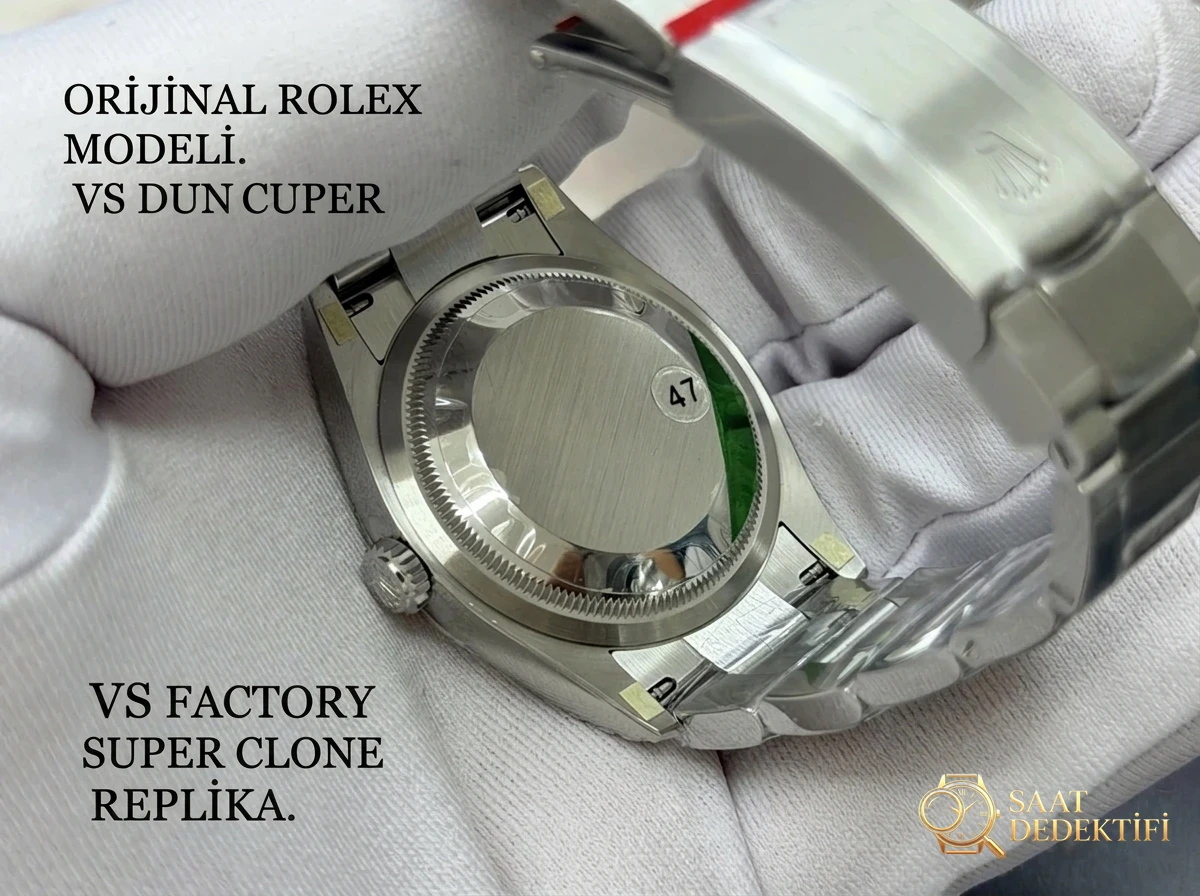
The back photo records a closed, full back cover and pod-tip area. Check that the back cover surround fits evenly, the brushing looks consistent in the photo, and there are no obvious deep marks cutting into the visible surface. A closed rear view does not provide access to the installed mechanism or seal. Therefore it cannot support a dismantling claim or any conclusions regarding waterproofing.
5. Oyster Type Band, Clip and Visible Markings
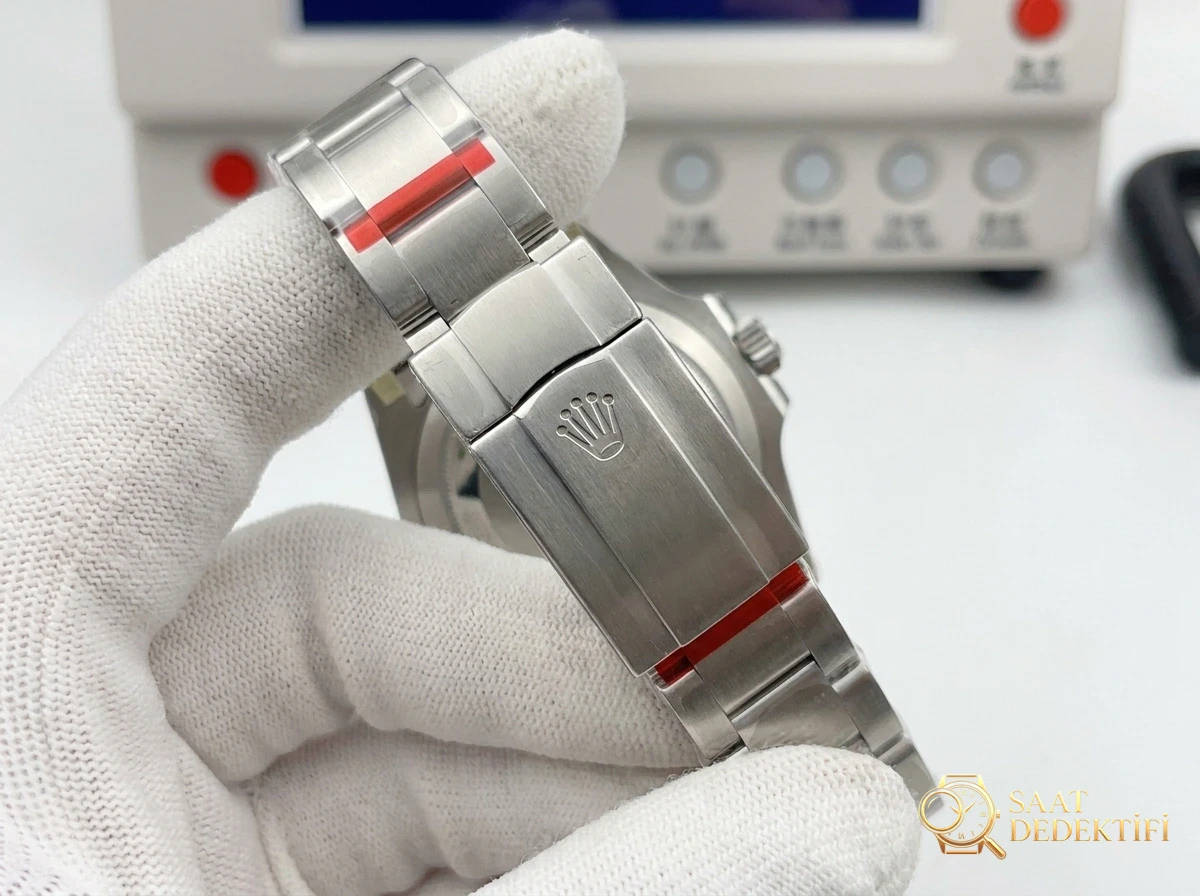
External clip appearance; Useful to evaluate overall consistency of workmanship, crown logo area, edge condition, and the way the cord enters the clip. Look for a visibly crooked bite, an unexpected gap, or a sharp mismatch in brushing direction. Film can alter visible color and texture, so if the seller's approval process allows it, the best final check is a clean photograph taken after the film has been removed.
Open clip photo; It adds folding blades, interior crafting, and stamped or engraved details. A visible sign reads U7T. This is just an observation about this photo. A code is not an independent factory certification, a universal batch key, or proof of a metal grade. Do not approve or reject a watch based on this sign alone.
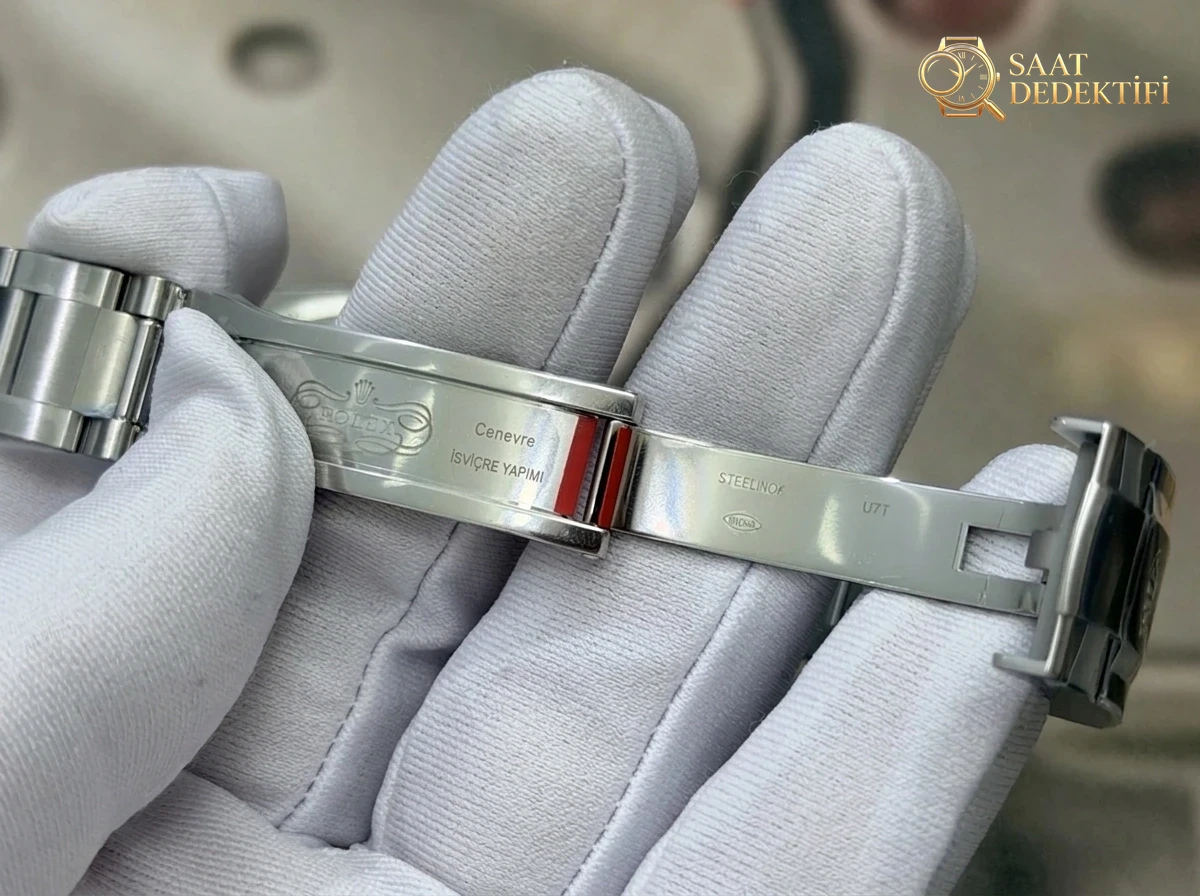
Still photos do not test clip strength. Ask the seller to show a complete open-close cycle, including both release points and the final locked position, in the full-unit QC video. Also request a brief view of the strand joint movement so that a stiff, bent or poorly seated link can be more easily identified before shipping.
6. Matching Product Video: What the Movement Adds
The locally hosted video is from the same product listing that is linked to. The multicolored dial gives a second illumination condition and shows how the bezel, crystal, indexes and polished surfaces react as the watch moves. This is especially useful because a single still image can exaggerate or suppress saturation.
7. Image of DD3230 and General Mechanism Listed by Supplier
The product page uses the designation DD3230. Therefore, the correct wording is “supplier-listed DD3230”, not “independently verified DD3230”. A catalog label helps identify the version a seller intends to offer, but it does not prove the installed mechanism in a closed watch or predict the performance of each unit delivered.
The vertical format mechanism photo below is included because it appears in the source material, but file comparison does not link it to the ten-image gallery for SKU VSF-19117. This is a general reference image that has already been used elsewhere. It can show the appearance of a decorated automatic mechanism and the visible bridge layout; can't reveal what's behind the closed back cover shown above.
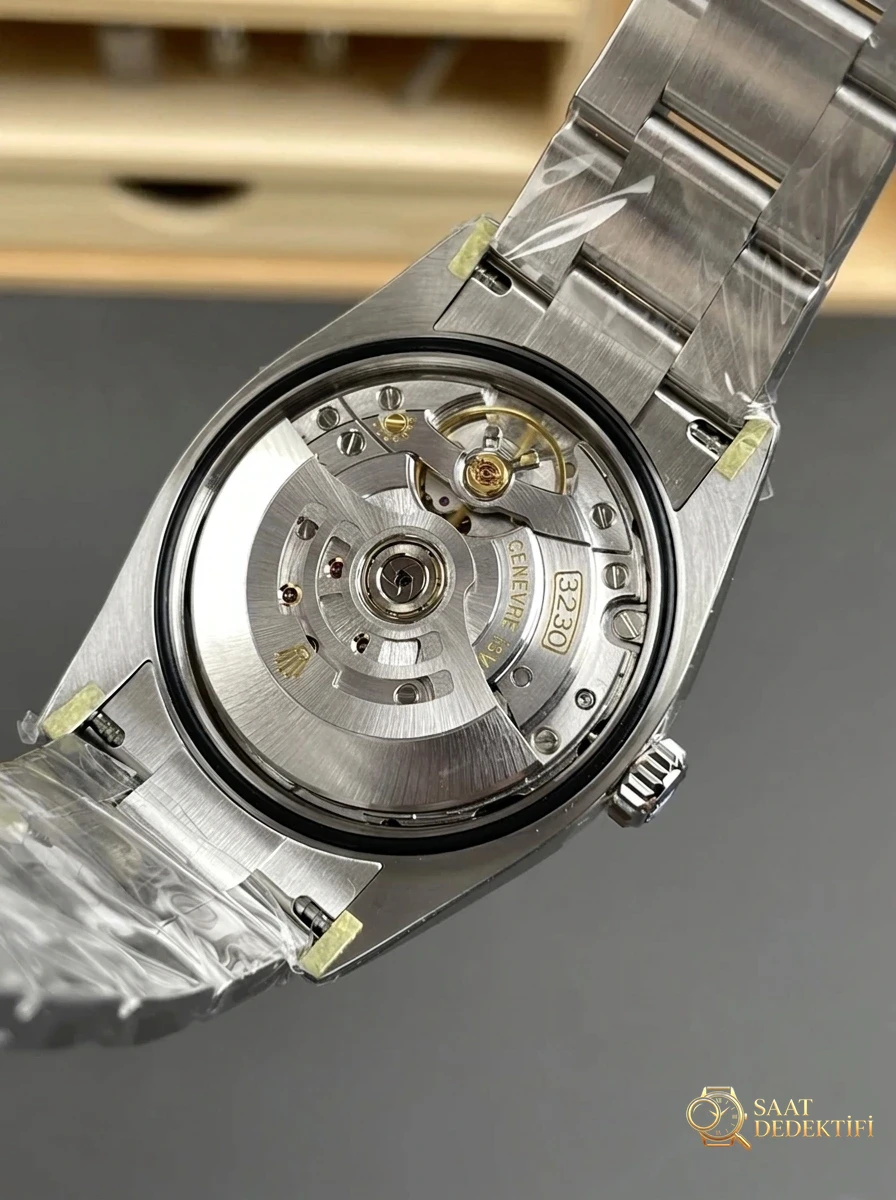
Mechanism questions require unit-specific evidence. Once the full case back has been opened, ask for a photo taken with the watch ID in the same order. For functional QC, request a continuous video of the winding, time setting, and hour-minute hand movement, as well as a dated timegrapher reading if speed behavior is important. A power reserve claim requires a fully established, time-stamped operation under specified conditions; There is no such attempt here.
The same caution applies to water exposure. Photos of the outer crown and back cover may identify obvious damage or poor fit, but they do not show the result of a pressure test. Treat intended swimming or immersion as a separate question of service and evidence, not as a conclusion drawn from model naming.
8. Technical and Visual Evidence Table
This table keeps the original design reference, catalog statements and observed sample details in separate columns. It is deliberately cautious so that a specification of the original watch is not presented as a test result for the VSF product.
| Subject | Registration | Result to the buyer |
|---|---|---|
| Original design basis | Rolex Oyster Perpetual 36, reference 126000, configuration m126000-0016. | Use only for design identity and official terminology. |
| VSF announcement | Item #9489, SKU VSF-19117. | This is the full internal product link for the article. |
| Dial | Multicolored repeating ROLEX-letter Jubilee motif. | Appears in the matching façade image and matching product video. |
| Nominal size family | 36mm on official original ID and VSF catalog title. | Catalog ID; The sample photographed was not measured here. |
| Case and band | The flat-bezel case, closed case back and Oyster-type strap are visible. | Examine the external situation and harmony; No metal-grade claims are made. |
| Mechanism | DD3230 is the supplier's advertising label. | Verify the installed mechanism and function on the exact unit. |
| Mechanism photo | General visual; Does not match product gallery. | Don't call this a teardown of this watch. |
| Timing, power reserve and water resistance | No unit-specific instrumentation or pressure-test records were provided. | No performance or waterproof promises are made. |
Photo photo decision matrix
| Media | best use | Follow up when uncertain |
|---|---|---|
| Front dial | Motif identity, index fit, hour-minute hands, minute track and visible print. | Ask for flat macro photos in diffused, angled light. |
| Crown side case | Frame fit, crown alignment, case transitions and ear silhouette. | Once you have identified the film, test both sides under harsh light. |
| Back cover | External condition, seating and link-end area. | Require a separate open-case sequence for movement identification. |
| Closed clip | Surface condition, crown logo area and bite alignment. | Request a full on-and-off video. |
| Open clip | Folding blades, hinge area and visible markings. | Test the function; Do not authenticate from a code. |
| Product video | Color response, reflections and appearance in action. | Request a dated, full-unit-specific functional video. |
| General mechanism visual | General visual reference only. | Do not use this sample for mechanism confirmation. |
9. Full-Unit QC Checklist Before Approval
- Confirm the ad.
- Confirm the motif. The surface should use a repeating multicolored ROLEX-letter grid, not interlocking circular bubbles.
- Ask for a flat front image. Keep the camera centered and move the hour and minute hands away from important text and indices.
- Check the central axis. Compare the crown logo, twelve index, hour-minute hands stack, and underprint against the vertical line of the dial.
- Examine color boundaries. Look for a clearly missing segment, obvious bleed, damage or debris; Verify suspected problems with an unfiltered macro.
- Compare lighting. Use a diffused still image, an angled still image, and a motion clip before deciding on saturation or workmanship.
- Inspect the case from both sides. After accounting for the film, check the bezel fit, crown alignment, lug symmetry, and visible signs of use.
- Inspect the back cover. Look for even fit and exterior damage, but do not infer a closed rear-mounted mechanism.
- Check both link ends. Confirm that the cord meets the case evenly and that no links appear bent or poorly seated.
- Test the clip. Ask for a continuous open-close sequence showing the hinge, release, and final lock.
- Treat marks as observations. Record visible codes for comparison without turning them into factory or batch warranties.
- Verify crown functions. Request a single continuous video covering winding, time setting, and return to normal crown position.
- Request measurements only when necessary. If fit is critical, ask the dealer to measure the exact unit with the vehicle visible rather than copying a catalog number.
- Separate functional tests. Obtain a dated timegrapher reading and an appropriate pressure-test record if these results are important to your use.
- Archive approved media.
A rejection must point to a single repeatable problem: for example, “the index at position six appears rotated in both straight photographs” or “the clip does not lock during continuous video.” Specific evidence is easier to decipher than a broad “better watch” plea and reduces the likelihood of mistaking a camera angle for a flaw.
10. Product, Categories and Related Guides
Frequently Asked Questions
Is this a Celebration dial?
No. This is a multi-coloured Jubilee motif made up of repeating letters ROLEX. A Celebration dial uses interlocking circular bubbles on a turquoise field, so the two names should not be used interchangeably.
What is the correct identity of the advertisement under review?
The site listing under review is item #9489, SKU VSF-19117, cataloged as an Oyster Perpetual 36 with reference 126000 and a multicolored Jubilee-motif dial.
Does the video show the matching product?
Yes. The locally hosted clip is attached to the same product record and shows the matching dial design in action.
Is the movement photo a teardown of this watch?
No. The mechanism photo is a generic reference image that does not match the gallery of the product under review. The matching rear photo shows a closed rear cover, so an opened, full-unit-specific row is required to visually identify the installed mechanism.
What does the DD3230 description prove?
DD3230 is the mechanism designation listed by the supplier. The movement alone does not guarantee provenance, timing accuracy or power reserve; These questions require evidence from the individual clock.
Does the visible U7T mark verify a factory or batch?
No. U7T is a visible mark in the clip photo provided. Record this as a photographed detail, not as an independent factory certificate, a universal batch code, or a material warranty.
Is water resistance guaranteed by case and crown photos?
No. Exterior photos may reveal obvious condition or fit issues, but they cannot detect waterproofing. If water exposure is significant, request a proper pressure-test record for the exact hour.
Resources for Original Design Foundation
- Rolex: Oyster Perpetual 36, m126000-0016
- Rolex Newsroom: New Oyster Perpetual 36
- Hodinkee: Introducing the Oyster Perpetual 36 Jubilee Dial
- Monochrome: Hands-On with the Multicoloured Jubilee Dial
Final rating: this listing is best considered a photo-based, full-unit specific purchase. Model mapping and five matching exterior images are strong; The supplier's movement label and separate general movement image are not a substitute for opening and testing the watch. If you maintain these boundaries, color dial evaluation becomes easier, not harder.
Saat Dedektifi Expert Score
Model: Rolex Oyster Perpetual 126000 · VSF Super Clone (A+)User Rating
64 people rated · Saat Dedektifi Verified Score
Rate this model:
Conclusion & Detective Verdict
VS Factory VSF Oyster Perpetual 36 Jubilee Dial Review Ref. As we saw in our 126000 Photo Analysis review, the precise tolerances of the case and the stable working character of the movement carry the model to the top level of its segment. Success in wrist ergonomics, material quality and optical details; This makes this watch a unique choice for collectors.
Frequently Asked Questions (FAQ)
Which movement is used in the Rolex Oyster Perpetual 126000 model?
In this model, the model's high stability integrated caliber or Swiss-norm Clone movement is used; Deviation tolerance is in the range of 2-5 seconds per day.
What is the case material and stainless steel quality?
Made from solid 904L/316L stainless steel with high corrosion resistance; It exactly reflects the original feeling of weight and texture.
Is there AR coating on the sapphire glass surface?
Yes. There is a colorless double-sided AR coating on the scratch-resistant sapphire crystal glass surface to prevent glare and reflection.
How is the waterproof performance?
With its seal-tested crown system, it is fully resistant to pressure up to 50-100 meters and daily water contact.
Does Saat Dedektifi have expertise assurance?
All technical controls, timegrapher measurements and case tolerances received full marks from Saat Detective expertise standards.