
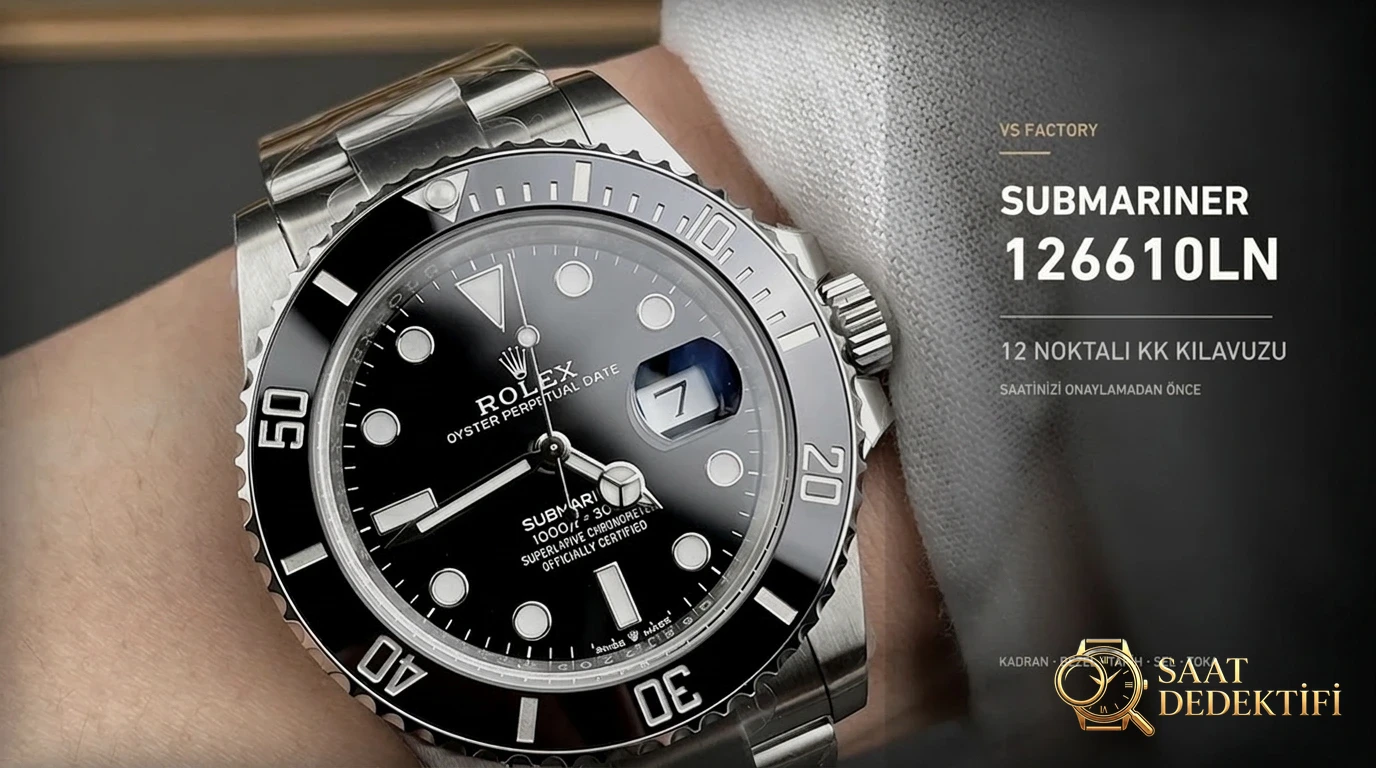
VSF Submariner 126610LN QC Guide: 12 Technical Checks Before Approval

VSF Submariner 126610LN QC guide handles the photos shared before approval with a 12-step component-based checklist rather than interpreting them from a single perspective; The goal is to question not only the watch, but also the camera angle, light and scope sent by the seller, as the approval process depends on both.
The bezel, rehaut, Cyclops window and Glidelock lock are both the most recognizable and the areas where the camera angle and reflections are the most misleading. Rather than judging from a single photo, a step-by-step approach is required that evaluates each component in its context.
The following list covers the twelve checkpoints that may be encountered in the VS Factory rendition of the Rolex Submariner 126610LN, in order from verification to movement; The issue of mechanism and timegrapher is only mentioned in the last article, as a brief context note. Although each item seems sufficient on its own, it gains its real credibility when read together with the previous one.
| Technical Parameter | Original Rolex Submariner 126610LN | VS Factory Super Clone QC Benchmark | Market Work Ordinary Replica |
|---|---|---|---|
| Full unit proof | Factory serial registration | Dial-lock-film pattern consistent set | Catalog frame only, unit uncertain |
| Bezel-pip alignment | Full overlap with pointer 12 | Overlap in neutral position, full rotation video desired | Judgment from a single frame, back play uncontrolled |
| Rehaut symmetry | Equal distance from the center | 12-6 axis and two sides are compared | Tilted single frame only |
| Wheel of history | Vertical centering, sharp printing | Verified with two samples of single and double digits | High risk of clipped digits |
| Glidelock movement | Continuous adjustment rail | Lock-security lock-setting sequence with video | Still image only |
| Timegrapher context | Specified test conditions | 20 sec+ video, location and arming status clear | Frozen single screenshot |
1. Full Unit Proof and Camera Geometry
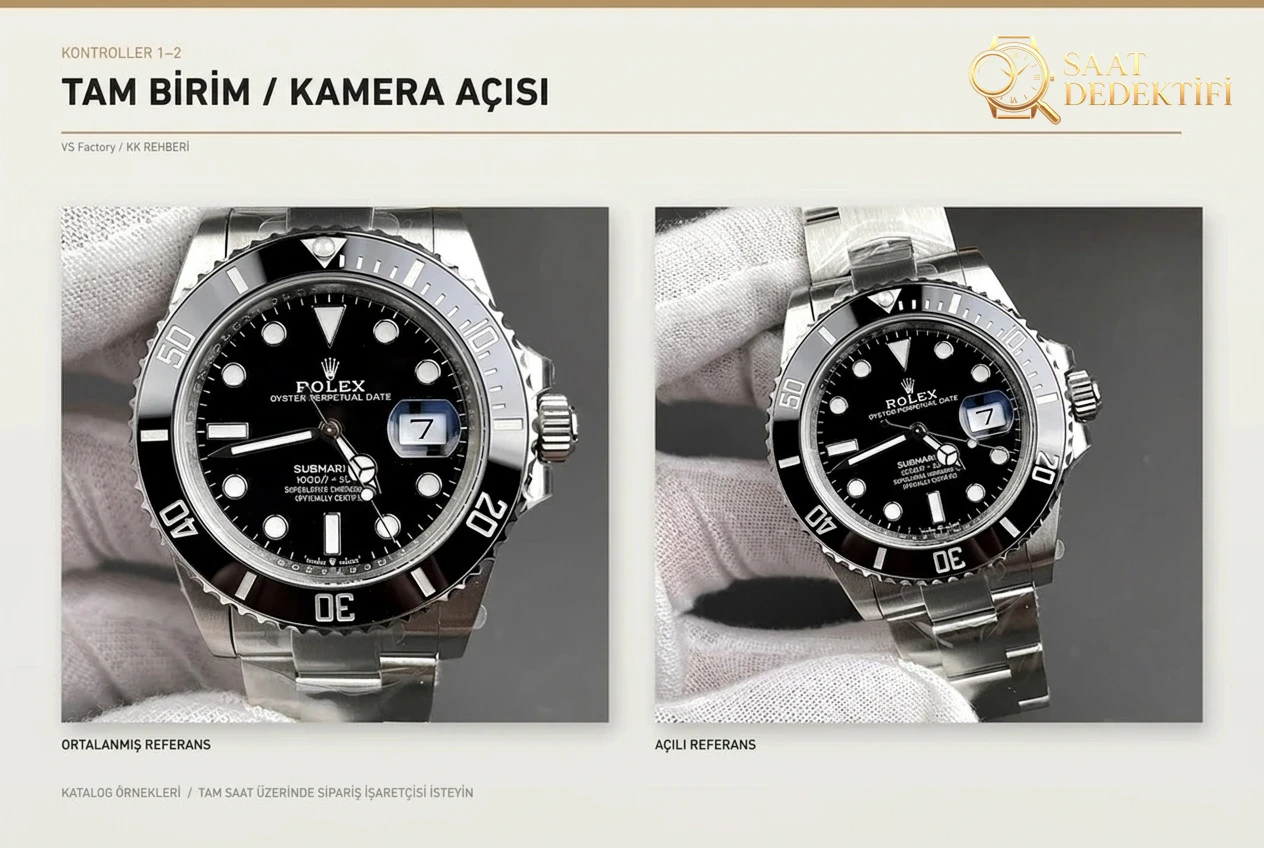
Catalog photos may identify the model but do not prove the exact unit; The dial, lock area and protective film pattern should be consistent throughout the set. In a frontal shot, the dial should appear circular, the ears should remain equal in size, and the axis from 12 to 6 should remain vertical; The alignment interpretation only makes sense once this geometry has been verified.
- Cutting lines and gluing marks on the protective film are also part of the same set; Since these details may show different patterns in different units, the film overlap between the dial and the lock area alone is considered an important authentication.
2. Dial, Bezel, Rehaut, Crystal and Date Wheel
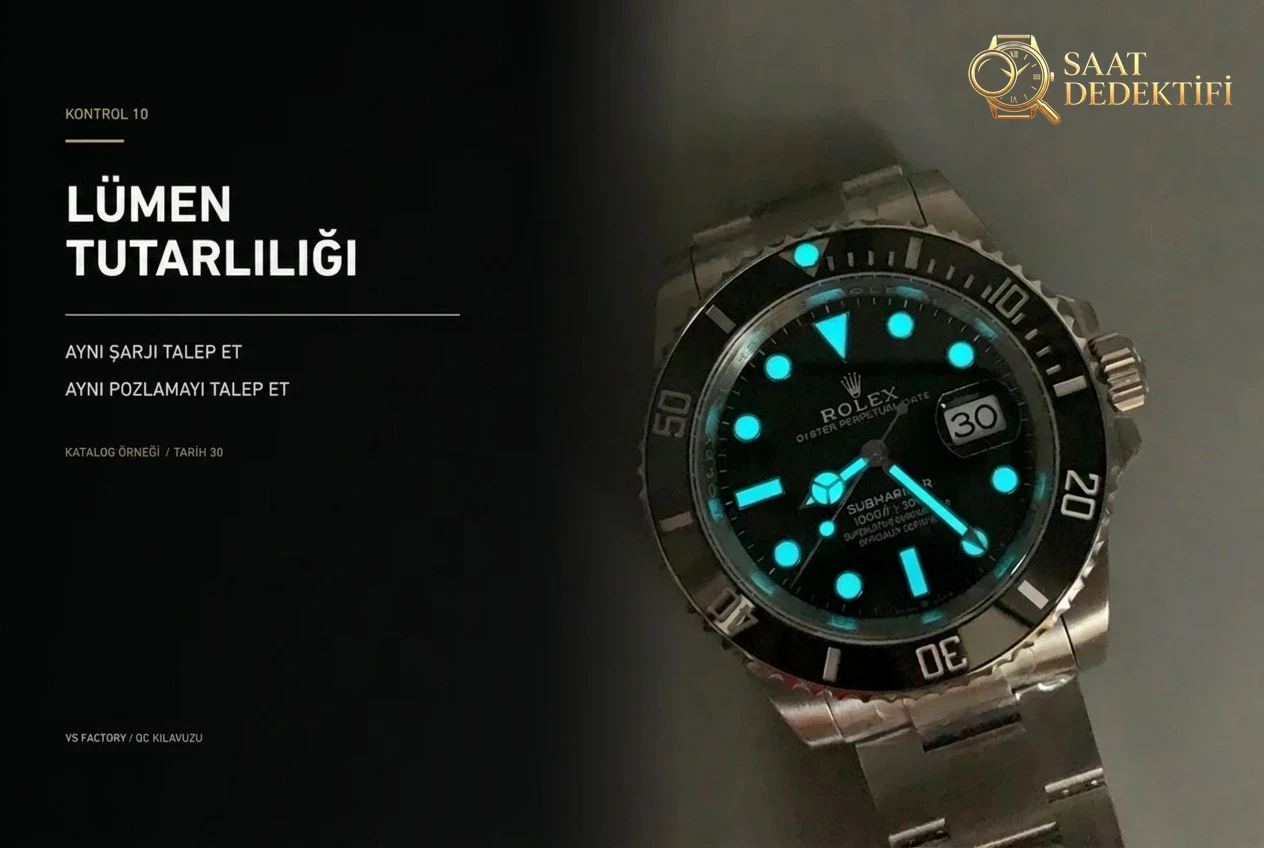
The bezel triangle and luminous pip are compared with marker 12 in the neutral position; this comparison should be supported by a slow full rotation video. Rehaut is read first from the 12-6 axis and then from the equal distance of the two sides to the center; For the crystal, two centered and shallow-angled images are required, and for the date wheel, two examples with single and double digits such as 8 and 25 are required.
- Cyclops magnification should not be overlooked at this stage: A centered overhead view can verify that the magnifying lens centers the date and does not leave any noticeable blurring at the edges. The number and depth of the bezel notches also provide a countable reference point in the neutral position photograph.
3. Case, Crown Protection and End Links
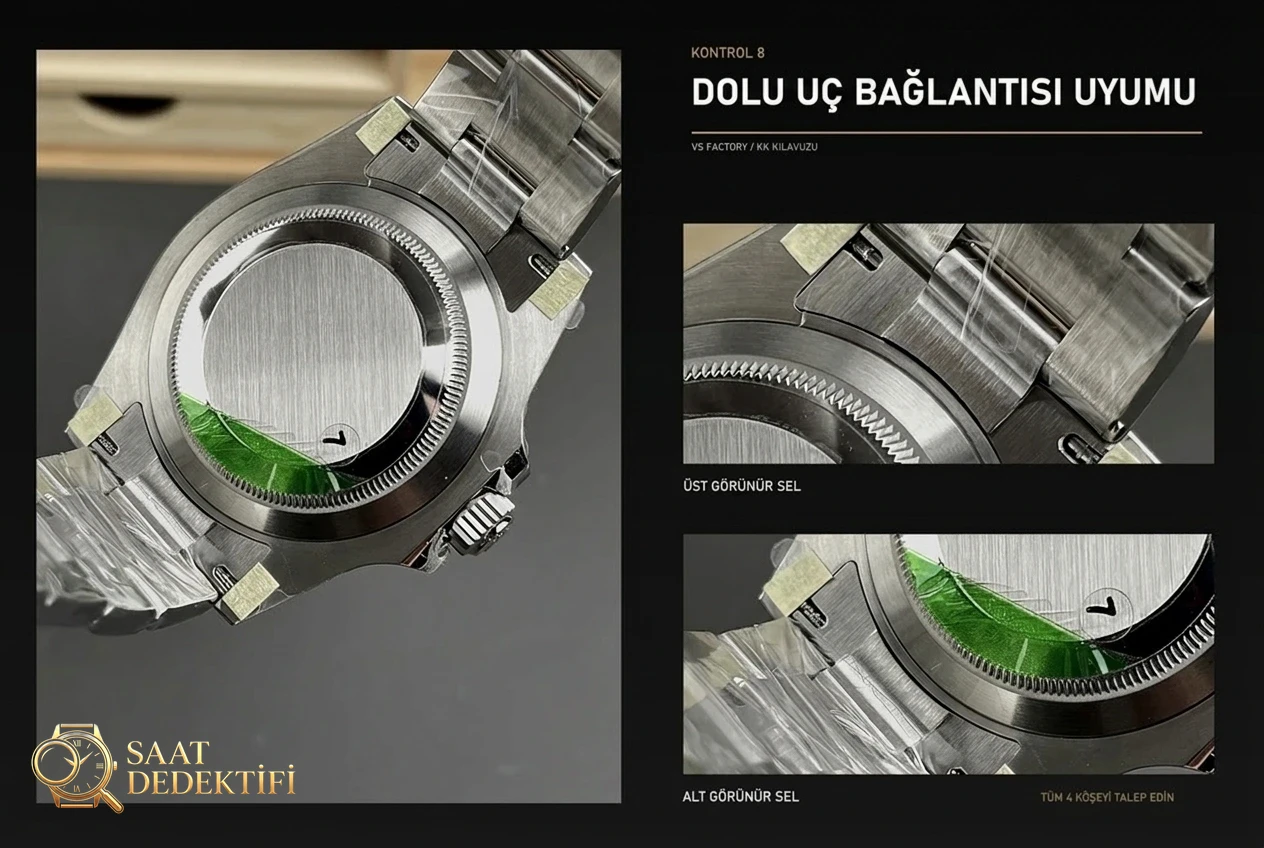
The crown guard shape, crown fit and bezel height are compared from matched side profiles; It should be clarified at this stage whether a suspicious trace is on the film or on the metal. The four massive end connections are examined in similar light; An open gap, a connection above or below the ear, or an irregular fit that distorts the angle of the bracelet are the main signs to look for.
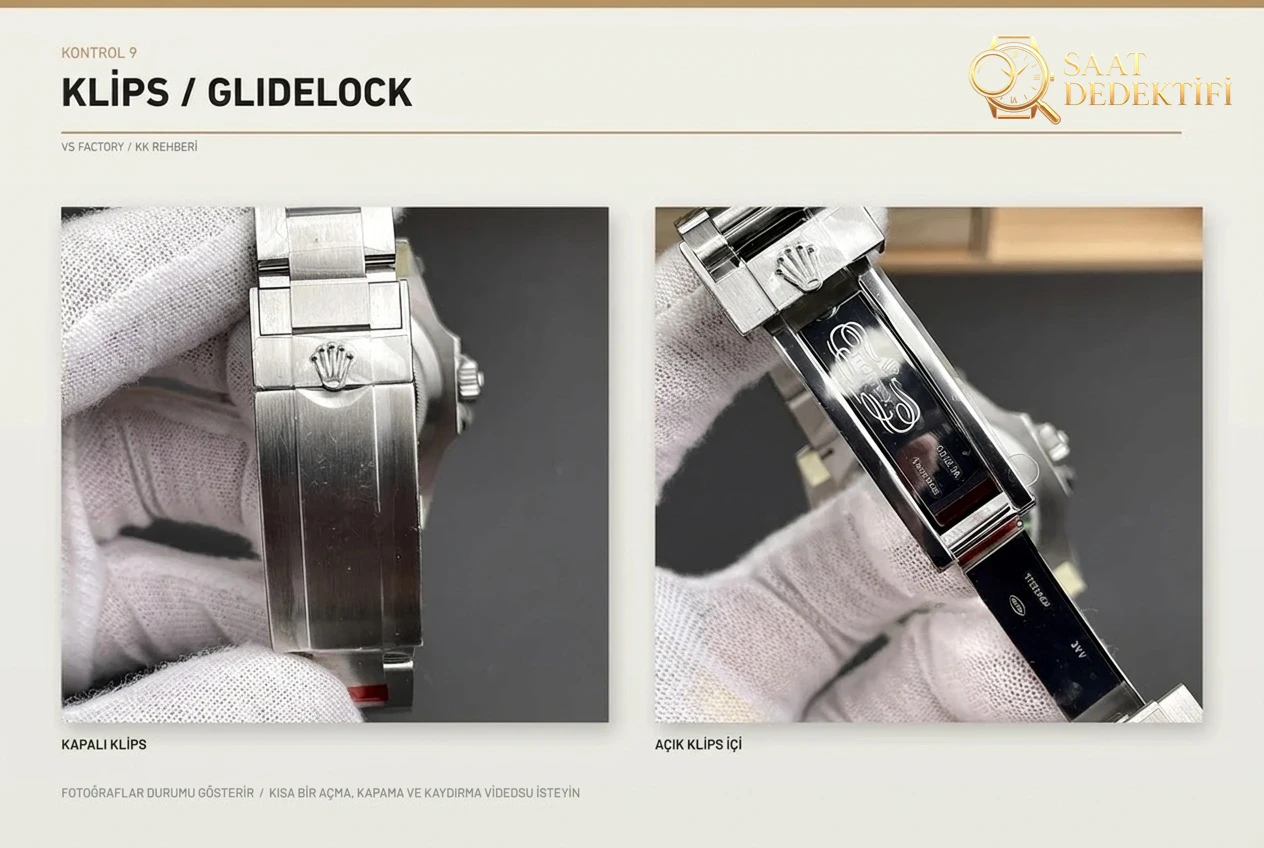
- The direction of brushing on the ear surfaces should also be compared under the same light condition; If there is a difference in direction or texture between the two ears, this usually indicates an inconsistency that occurred during assembly and should be clarified with an additional image.
4. Wristband, Safety Lock and Glidelock Movement
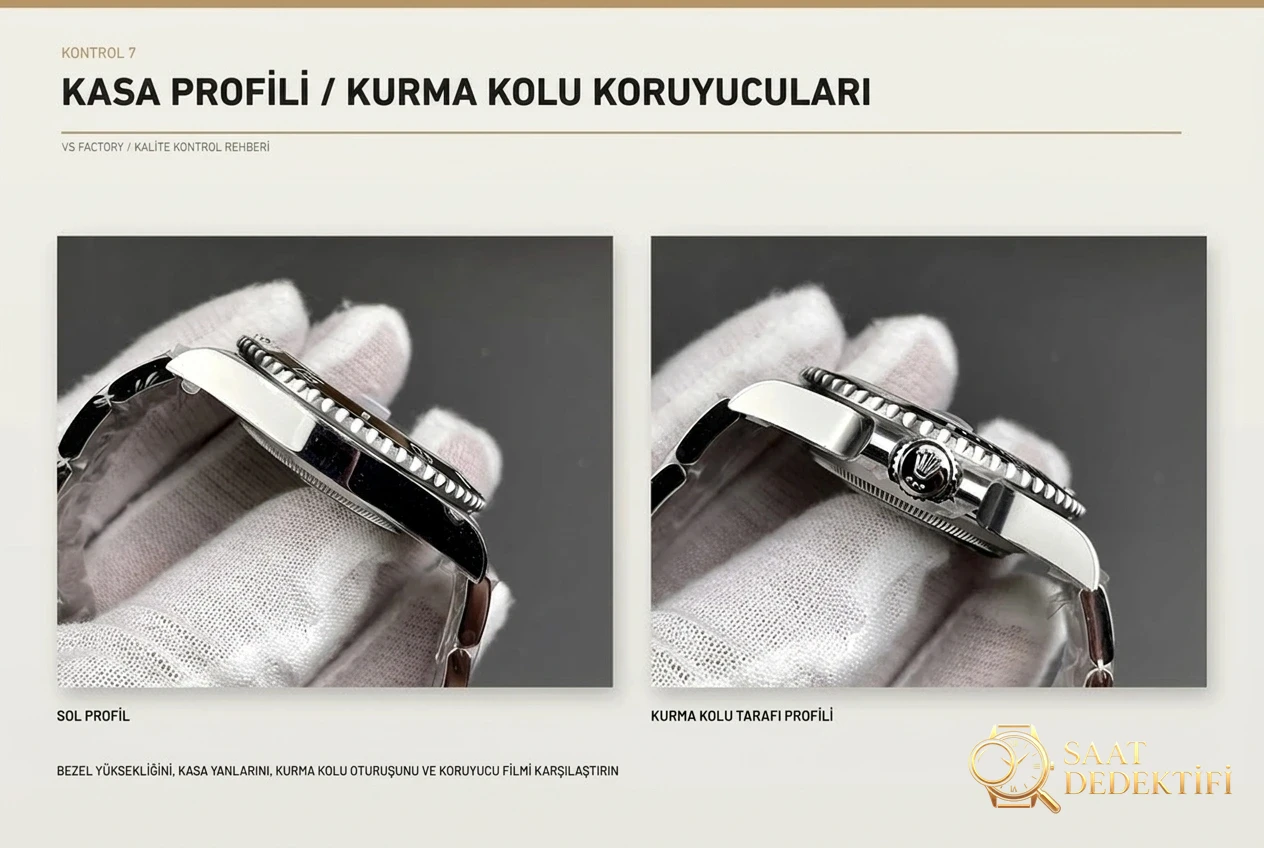
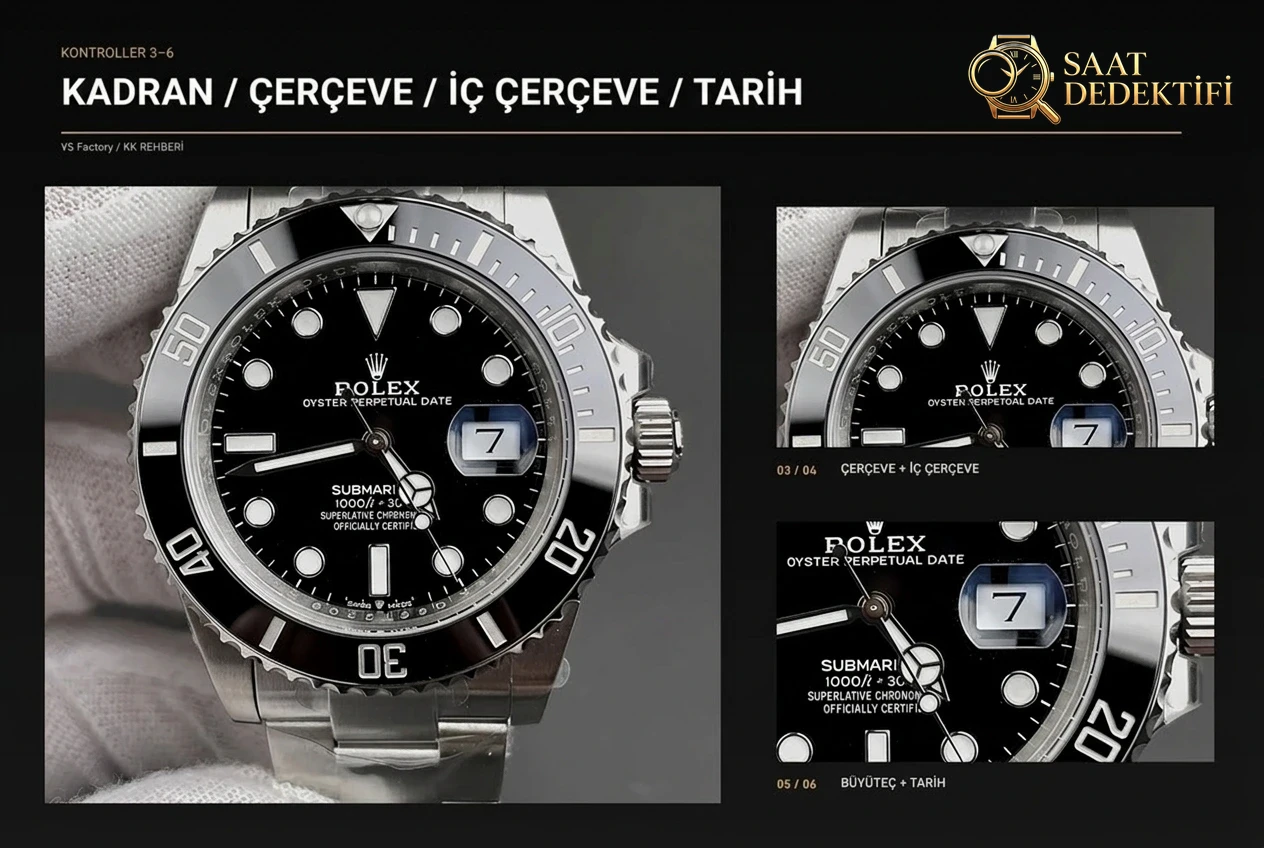
Still images show the craftsmanship but not the actual behavior of the Glidelock; The opening and closing of the lock, the engagement of the safety lock, and the sliding of the adjustment rail through several positions should be requested in one continuous video. A linkage or spring bar that loosens abnormally under light use is the main risk that can be noticed at this stage.
5. Lume Charge Consistency Check
Since charging time and exposure can easily change the result, it is desirable to charge the hour-minute hands, hour points and bezel pip at the same time and from the same source; Images taken without changing camera settings are compared both immediately and after a few minutes. A single lume frame from the catalog is not considered matched evidence.
6. Single Article and General Approval Decision for the Mechanism
On the mechanism side, all that is required is a stable timegrapher video of at least 20 seconds, with the test position, winding state and swing speed indicated; A single frozen screenshot proves nothing. Approval is given when all the twelve items above are consistent; If any of them can only be verified from a single angle, it is always safer to ask for a flat, additional image.
- It is beyond the scope of this guide to go beyond this single article and delve into issues such as the origin of the movement: spare parts compatibility or long-term performance; such questions are answered in more depth in a separate review article dedicated to the VS3235 mechanism.
General Evaluation
This list of twelve points systematically covers the points where decisions made from a single perspective most often go wrong; From the bezel to the Glidelock, from the date wheel to the lume charge, each component is evaluated in its own context. In the VS Factory comment the mechanism is only included in the last step, as a brief timegrapher's note; What really determines the approval decision is that the twelve articles consistently confirm each other. This approach transforms the approval process from a momentary impression into a repeatable method.
Saat Dedektifi Expert Score
Model: Submariner 126610LN QC Guide · VS Factory Super Clone (A+)User Rating
41 people rated · Saat Dedektifi Verified Score
Rate this model:
Conclusion & Detective Verdict
Saat Dedektifi Lab Score: 9.2 / 10
This list of twelve points systematically covers the points where decisions made from a single perspective most often go wrong; From the bezel to the Glidelock, from the date wheel to the lume charge, each component is evaluated in its own context. In the VS Factory comment the mechanism is only included in the last step, as a brief timegrapher's note; What really determines the approval decision is that the twelve articles consistently confirm each other. This approach transforms the approval process from a momentary impression into a repeatable method.
Frequently Asked Questions (FAQ)
VSF Submariner 126610LN Where are the most common errors in QC photographs?
It occurs in tilted frames where the camera angle makes the alignment of the bezel and bezel look different than it actually is; so centered and straight angle images always take priority.
Why is video more reliable than photo for Glidelock testing?
Because the real behavior of the lock and adjustment rail is only seen during movement; A fixed square does not provide information about looseness or resistance.
Why is the mechanism discussed in only one article in this guide?
Because the focus of this page is on the twelve visual-mechanical checkpoints in the approval process; Detailed performance review of the VS3235 mechanism is the subject of a separate article.