
Winding Watches vs. Automatic Watches
Self-winding and hand-wound watches: let's explore why people love each and find out which one is best for you.
"Should I buy a winding watch or an automatic watch?"
I wish I got XXX every time someone asked this question...
Today we will talk about the differences between automatic watches and hand-wound watches, also known as winding watches. We'll also give you some insight into how to use each of these watches and how these different types of watches work, so you can better appreciate the differences.
Wind-Up Watches and Automatic Watches
All mechanical watches work with a spring firmly installed inside the watch. This spring is known as the mainspring. All mechanical watches must be wound to work. Winding is usually done with the crown (a button usually located on the side of the watch case), and in some cases with a winding key.
What is the mainspring?
The mainspring is a spring that is tightly wound inside the watch and holds a certain amount of tension, just like a tape measure. This tension is gradually released through a series of gears, parts and screws. As tension is released, the energy resulting from this release is transferred to other mechanical parts. These parts are called gear set and escapement; these essentially run the clock and keep everything moving. The rotor ensures a regular flow of energy in the caliber (mechanical mechanism) by keeping the mainspring tightly wound.
Automatic watches require less from you in daily use. An automatic watch (also known as a self-winding watch) allows you to use your mechanical watch without having to wind it every day. However, there are times when you need to wind an automatic watch, but that is the subject of another article.
Winding watches are not self-winding like automatic watches, so you need to wind them by hand, or sometimes with a special tool, for the watch to work. It's similar to a manual transmission where you have to be more hands-on to use it.
There was a time in history when every watch was hand-wound, and watchmaking evolved over many years. Automatic watches, that is, self-winding watches, first appeared with the invention of the rotor, and at that time an automatic watch was called "perpétuel" (French for perpetual).
What is the Difference Between Automatic Watches and Hand-Wound Watches?
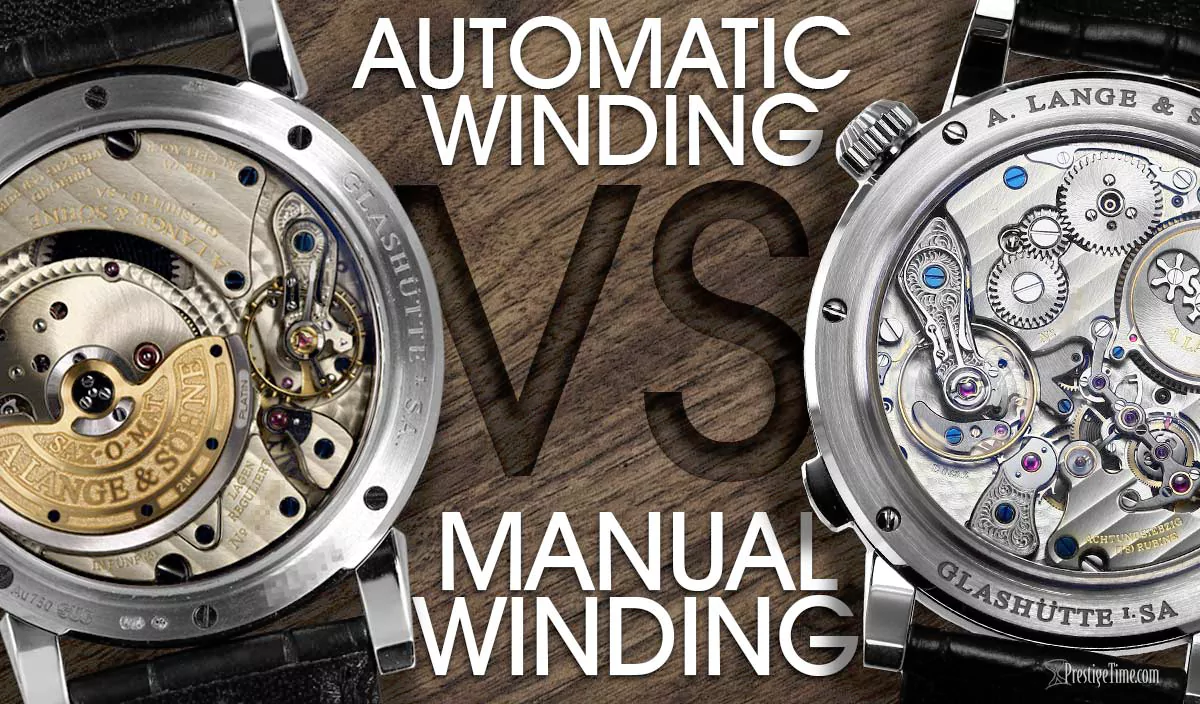
In self-winding (automatic) watches, a rotor is connected to the watch's mechanism; So when he moves his wrist, the rotor rotates and compresses the mainspring, winding the watch again. A hand-wound watch has no rotor and therefore must be wound by hand to work.
Click for more information about self-winding watches.
Self-Winding/Automatic Watches
Pros
Many people buy automatic watches for the convenience of being able to simply wear the watch and use it without having to worry about winding it beforehand. As a result of the above, the overall watch market offers a much wider range of options in automatic watches compared to hand-wound watches.
Cons
The rotor is weighted and since it is a weighted rotor, it causes the watch to be heavier and thicker. For some people this might be a minus, for others it isn't, but it's still worth mentioning. For people who like to watch gears turn through a transparent case, the rotor may be a bit of an obstacle because it hides part of the mechanism.
Hand-Wound / Winding Watches
Pros
For those who admire the micro-mechanics in a mechanical watch, a hand-wound watch with a transparent case back is a huge plus because it allows you to see more of the movement. The absence of a weighted rotor in a winding watch allows watchmakers to make the mechanical movement significantly thinner and lighter on the wrist.
Cons
Those who aren't interested in the inner workings of their manual watches and wear them just to see the time may find the daily crown ritual a bit tedious at times. Constantly turning the crown to wind the mainspring can cause premature wear of the crown seal (compared to automatic watches, which are often wound via the rotor).
If you liked this comparison and think others will too, please like and share. Thank you!
Saat Dedektifi Expert Score
Model: Winding Watches Automatic Standard Series CloneUser Rating
31 people rated · Saat Dedektifi Verified Score
Rate this model:
Conclusion & Detective Verdict
As seen in our technical review of the Winding Watches Automatic model; The optical tolerances of the case, the dial typography and the stable operating character of the mechanism take the model to the top level of its segment. It is a perfect choice for collectors with its wrist ergonomics, material quality and micron level finishing success.
Frequently Asked Questions (FAQ)
Which mechanism is used in the Automatic Winding Watches model?
In this model, the model's high stability integrated caliber or Swiss-norm Clone movement is used; Deviation tolerance is in the range of 2-5 seconds per day.
What is the case material and stainless steel quality?
Made from solid 904L/316L stainless steel with high corrosion resistance; It exactly reflects the original feeling of weight and texture.
Is there AR coating on the sapphire glass surface?
Yes. There is a colorless double-sided AR coating on the scratch-resistant sapphire crystal glass surface to prevent glare and reflection.
How is the waterproof performance?
With its seal-tested crown system, it is fully resistant to pressure up to 50-100 meters and daily water contact.
Does Saat Dedektifi have expertise assurance?
All technical controls, timegrapher measurements and case tolerances received full marks from Saat Detective expertise standards.